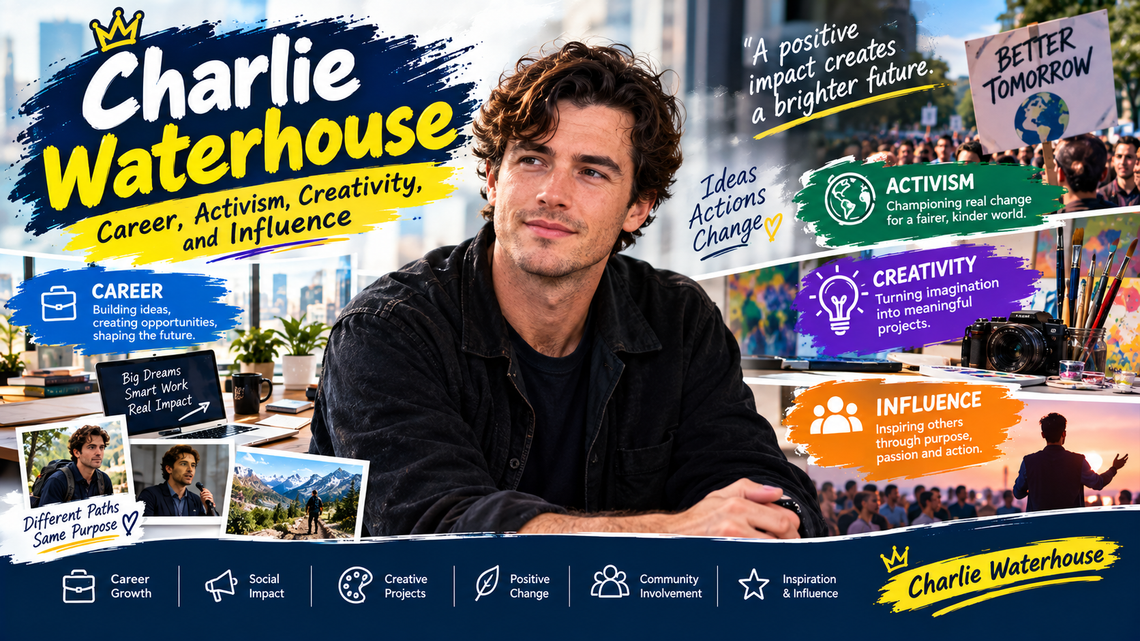
Charlie Waterhouse is a British creative strategist, designer, writer, and activist whose work sits at the intersection of culture, communications, environmentalism, and social change. He is particularly known for his involvement in the creative development of Extinction Rebellion (XR), as well as his work with cultural projects and community-focused initiatives.
Rather than following a traditional career path, Waterhouse has built a reputation around using creativity and communication to influence public conversations. His work demonstrates how design, art, storytelling, and activism can work together to bring attention to important social and environmental issues.
Who Is Charlie Waterhouse?
Charlie Waterhouse is a London-based movement and communications strategist. According to his professional profile, he was part of the creative team that helped start Extinction Rebellion in 2018 and has also been associated with the cultural collaboration Hard Art.
His professional background includes creative direction, communication strategy, design, and cultural activism. He has also worked through creative organizations and projects that explore the relationship between art and social movements.
Some of the areas associated with Charlie Waterhouse include:
- Creative strategy
- Communications
- Graphic design
- Environmental activism
- Cultural projects
- Community development
- Social change
- Movement building
- Art and activism
This combination has made him an interesting figure for people researching modern activism and the role of creativity in social movements.
Charlie Waterhouse and Extinction Rebellion
One of the most significant parts of Charlie Waterhouse’s public profile is his connection with Extinction Rebellion. The environmental movement became internationally recognized for its campaigns highlighting the urgency of the climate crisis.
Waterhouse and fellow creative professional Clive Russell worked on the visual communication associated with Extinction Rebellion. A UK Intellectual Property Office decision records that the pair worked with Extinction Rebellion founders and contributed to the movement’s graphic design and branding.
The visual identity of a social movement can be extremely important. Symbols, posters, colors, typography, and simple messages can help transform complex political or scientific issues into ideas that ordinary people can immediately recognize.
This was particularly relevant to Extinction Rebellion because the movement needed a recognizable identity that could work across demonstrations, posters, websites, social media, and other forms of communication.
The Role of Creativity in Activism
Charlie Waterhouse’s career illustrates an increasingly important idea: activism is not limited to protests or political campaigning. Creativity can also become a powerful tool for social change.
Designers and artists can help movements communicate their ideas in ways that are memorable and accessible. A strong visual identity can give people a shared sense of belonging while making a campaign easier to recognize.
Waterhouse’s work demonstrates several ways creativity can support activism:
- Creating recognizable visual identities
- Making complicated issues easier to understand
- Giving campaigns a distinctive public presence
- Encouraging people to participate
- Connecting art with political and environmental ideas
His approach is therefore less about design as decoration and more about design as a communication and organizing tool.
Charlie Waterhouse and Hard Art
Waterhouse has also been connected with Hard Art, a cultural collaboration that explores the relationship between creativity and social change. His work in this area reflects a broader interest in using culture as a way of bringing people together.
Hard Art and related creative projects demonstrate the idea that cultural activity can play a role in political and community conversations. Music, visual art, performance, design, and storytelling can all help people discuss difficult subjects in new ways.
This approach is particularly relevant to environmental activism, where communicating urgency without overwhelming audiences is a major challenge.
Work in Culture and Community
Beyond environmental activism, Charlie Waterhouse has been involved in projects connected with communities and urban culture. He has been associated with the Brixton Pound and the Brixton Project, initiatives that explore local economies, community participation, and alternative approaches to social development.
The Brixton Pound, for example, became known as a complementary local currency designed to encourage economic activity within Brixton. Waterhouse’s involvement reflects his interest in practical community initiatives as well as large-scale campaigning.
His work has therefore covered more than one issue. At its core is an interest in how communities can organize, communicate, and create alternatives to established systems.
Charlie Waterhouse’s Communication Philosophy
A major theme running through Waterhouse’s work is the importance of communication. Social movements can have strong ideas, but those ideas need to be communicated effectively if they are going to reach a wider audience.
His career suggests that successful communication can involve:
- Clear and memorable messages
- Strong visual design
- Cultural participation
- Community involvement
- Storytelling
- Collaboration
- Creative experimentation
This philosophy is particularly useful in an era when people receive information through social media, news websites, videos, posters, and other highly visual platforms.
Why Is Charlie Waterhouse Notable?
Charlie Waterhouse is notable because much of his influence has come from behind the scenes. Unlike traditional celebrities, his public profile is largely connected to the movements, organizations, and creative projects he has helped develop.
His work shows how people working in design and communications can have an influence far beyond the traditional creative industries.
His association with Extinction Rebellion is especially significant because the movement became one of the most visible environmental campaigns of the late 2010s and early 2020s. The distinctive visual language used by the movement helped make its campaigns immediately recognizable.
Charlie Waterhouse’s Approach to Social Change
Waterhouse’s work can be understood through several broad principles:
- Creativity: Using art and design to communicate ideas.
- Collaboration: Working with other artists, organizers, and communities.
- Communication: Turning complex subjects into accessible messages.
- Participation: Encouraging people to become active rather than passive observers.
- Culture: Recognizing the role of art and cultural activity in social change.
- Community: Supporting projects that create stronger local connections.
These principles help explain why his career has moved between design, activism, community initiatives, and cultural work.
Public Interest in Charlie Waterhouse
Interest in Charlie Waterhouse has grown alongside wider public interest in the people behind modern activist movements. While Extinction Rebellion is widely recognized, many people are less familiar with the designers, strategists, artists, and organizers who helped shape its public identity.
Waterhouse represents this less visible side of activism. His contribution demonstrates that movements depend on many different types of expertise, including communication and creative direction.
His professional work also highlights how the boundaries between activism, art, design, and community development can increasingly overlap.
Conclusion
Charlie Waterhouse is a notable figure in contemporary creative activism. His work combines communication, design, culture, and social engagement, with his involvement in the creative development of Extinction Rebellion being one of the most recognized aspects of his career.
From environmental campaigns to community-focused cultural projects, Waterhouse has explored how creativity can help people understand important issues and participate in collective action.
His career is a useful example of how modern social movements rely not only on organizers and campaigners but also on designers, artists, strategists, and communicators. In a world where visual communication plays an increasingly important role, the work of people such as Charlie Waterhouse shows how creativity can become an important part of social and environmental change.