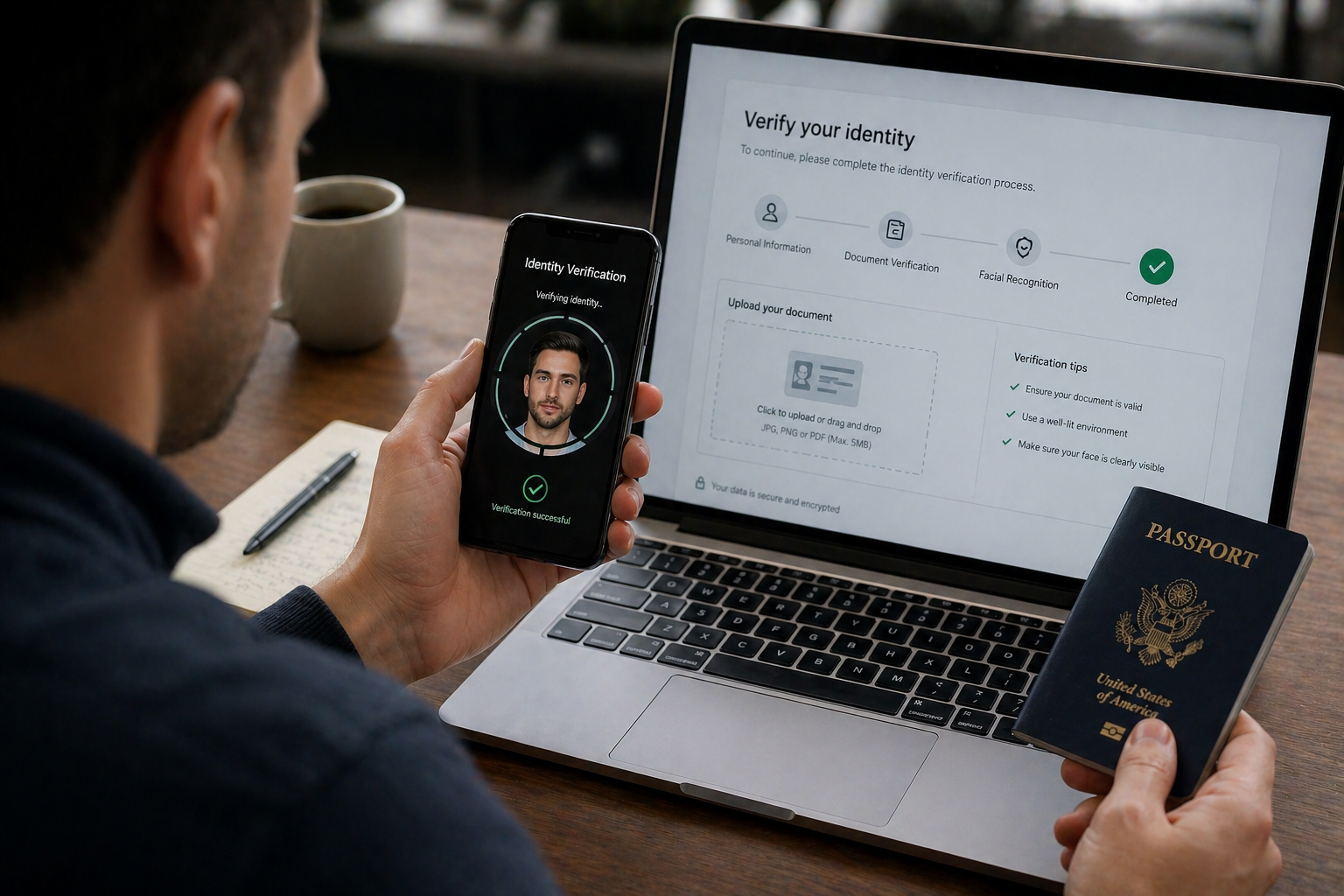
The internet was built without an identity layer. For decades, that design gap was treated as a feature. Anonymity felt liberating, and the friction of proving who you were seemed at odds with the speed and openness of digital life. But as online commerce, financial services, and social interaction have scaled to encompass virtually every aspect of modern life, that original omission has become one of the defining challenges of the digital economy.
Fraud is more sophisticated than ever. Regulatory expectations are more demanding than ever. And the bar set by consumers who want to know that the platforms they use have actually verified the people on them has never been higher.
Identity verification is the answer the industry has arrived at. Not as a blunt security checkpoint, but as a sophisticated, AI-powered layer of trust that sits invisibly beneath the surface of the digital experiences we use every day. This is how it works, why it matters, and where it is heading.
What Identity Verification Actually Is
At its simplest, identity verification is the process of confirming that a person is genuinely who they claim to be. That definition has remained constant for centuries; it is the same question a bank manager was asking when they inspected a signature card in the 1950s. What has changed dramatically is the context, the technology, and the scale at which the question needs to be answered.
A modern digital identity verification system does not rely on a human looking at a document across a desk. It uses a combination of optical character recognition, machine learning, biometric analysis, and real-time database lookups to assess identity with a speed and accuracy no manual process could match. When a user submits a passport photograph and a selfie to a platform, the system can, within seconds, confirm whether the document is genuine, whether the face in the selfie matches the document, and whether the person is physically present rather than submitting a static image or a deepfake.
The result is a verified identity: a confirmed link between a digital account and a real, specific human being. That link is the foundation on which trust, compliance, and security are built in the digital economy.
Why the Stakes Have Never Been Higher
Identity Fraud Is Growing Faster Than Legacy Systems Can Handle
The case for modern identity verification services is written in fraud statistics. In the UK, Cifas, the national fraud prevention service, reported more than 237,000 cases of identity fraud in 2023, representing the largest single category of fraud by volume. The losses run into billions of pounds annually, borne by financial institutions, businesses, and the individuals whose identities have been compromised.
What makes the current landscape particularly challenging is not just the volume of fraud but its sophistication. The fake ID problem has evolved well beyond poorly laminated cards and altered photographs. Today’s fraudsters have access to AI-generated identity documents that are visually indistinguishable from the genuine article, to stolen identity data available on dark web marketplaces, and to deepfake video technology capable of defeating basic biometric checks. The threat has industrialised, and a response built on manual document review or simple automated formatting checks is no longer adequate.
Consumer Expectations Have Shifted Too
Alongside the fraud imperative, there is a trust imperative. Research consistently shows that consumers are increasingly willing to complete identity checks when they understand what the verification is protecting and that they actively prefer platforms which take verification seriously. In markets ranging from financial services to online marketplaces and dating platforms, a verified community is a more trusted community, and a more trusted community is a more commercially successful one.
The businesses winning in digital-first sectors are often those that have recognised identity verification not as a cost of compliance but as a feature that their users genuinely value.
How Modern Identity Verification Works
The inner workings of a contemporary identity verification solution are more layered than most users realise, and that complexity is precisely what makes them effective. The process typically moves through several distinct stages, each designed to catch a specific category of fraud or error.
Document Capture: The user submits a photograph or scan of a government-issued identity document, a passport, driving licence, or national identity card. Most systems handle this via smartphone camera, with real-time guidance to ensure the image is clear, correctly framed, and free from glare. Biometric passport holders may also be able to use NFC reading, which extracts data directly from the chip embedded in the document and provides a higher level of assurance than a visual scan alone.
Document Authentication: The captured image is subjected to a multi-layer analysis: formatting checked against authoritative document templates, security features assessed for signs of tampering, machine-readable zones (MRZ) decoded and cross-referenced, and microprint and holographic elements evaluated where the image resolution allows. AI models trained on millions of genuine and fraudulent documents power this stage, and they are able to identify manipulation that would be invisible to a human reviewer.
Biometric Matching: The user submits a selfie or a short video clip. Facial recognition algorithms compare the face captured in real time against the photograph on the identity document, producing a confidence score based on a geometric and textural analysis of the two images.
Liveness Detection: This step is critical and often underappreciated. Liveness detection confirms that the person submitting the biometric is physically present, not a photograph held up to a camera, a printed mask, or a deepfake video. The most robust implementations are independently certified to recognised standards, such as iBeta Level 1 and Level 2, which assure that the liveness system has been tested against known attack vectors.
Decision and Integration: The verification outcome is returned to the platform via an Identity Verification API, which connects the verification provider’s system to the business’s own onboarding or account management infrastructure. This API-based architecture is what makes modern identity verification scalable. Businesses do not need to rebuild their platforms to implement verification; they integrate via API and receive structured results programmatically, in real time.
Where Identity Verification Is Being Applied
The applications of ID verification now span the full breadth of the digital economy. Some sectors have been subject to verification requirements for years; others are only now catching up.
Financial Services and Banking: The financial services sector is the most mature adopter of identity verification, driven by longstanding Know Your Customer (KYC) obligations. Banks, lenders, payment processors, and investment platforms are legally required to verify customer identity before establishing a relationship. The Financial Conduct Authority (FCA) in the UK sets and enforces these standards, and firms that fail to meet them face enforcement action and significant financial penalties.
Cryptocurrency and Digital Assets: As cryptocurrency has moved from niche to mainstream, it has attracted the same regulatory scrutiny as traditional financial services. Exchanges and digital asset platforms operating in the UK are required by the FCA to implement KYC procedures equivalent to those applied by regulated banks. The same identity verification infrastructure that serves a high street lender is increasingly serving a crypto exchange.
Age-Restricted Sectors: Online gambling, alcohol retail, adult content, and certain categories of digital service are legally required to confirm user age before granting access. Self-declared dates of birth are not verification a credible ID verification solution tied to actual identity documents is the only method that withstands regulatory and legal scrutiny. The UK Online Safety Act has sharpened the expectations in this space considerably.
Legal and Professional Services: Solicitors, accountants, estate agents, and other regulated professionals are subject to anti-money laundering (AML) requirements that include client identity verification. As these professions have shifted to remote working and digital client engagement, the adoption of identity verification software has accelerated significantly.
Healthcare and Telehealth: Patient identity verification protects sensitive medical records, prevents prescription fraud, and ensures that remote consultations are conducted with the registered patient. As telehealth becomes a permanent fixture of UK healthcare, digital identity checks are following.
Online Marketplaces and the Gig Economy: From peer-to-peer rental platforms to freelance marketplaces and ride-hailing services, identity verification reduces fraud, protects participants, and, where regulated services are involved, fulfils legal obligations. Verified profiles command greater user trust and, on platforms where reputation is currency, that trust has real commercial value.
The Regulatory Landscape Driving Adoption
Understanding why businesses are investing in identity verification requires understanding the regulatory environment that is compelling them to do so.
In the United Kingdom, the Financial Conduct Authority is the primary regulatory force in financial services, with explicit requirements around customer identity verification built into its AML and KYC frameworks. Its enforcement record, which includes multimillion-pound fines for firms with inadequate verification procedures, makes the consequences of non-compliance concrete.
Broader legislative developments are extending verification requirements beyond financial services. The UK Online Safety Act introduces age assurance obligations for platforms hosting age-restricted content. The Economic Crime and Corporate Transparency Act 2023 strengthens identity verification requirements for company directors registered at Companies House, a significant expansion of the verification perimeter in UK corporate law.
At the European level, the Fifth and Sixth Anti-Money Laundering Directives (5AMLD and 6AMLD) set standards that the UK incorporated before Brexit and continues to reflect in domestic legislation. The Financial Action Task Force (FATF), which sets global AML standards across more than 200 jurisdictions, provides the international framework within which all of these domestic regulations sit.
The trajectory is consistent across jurisdictions: more sectors, higher standards, and a clear shift from broad principles to specific technical requirements. For businesses, the practical implication is straightforward: the cost of non-compliance is rising faster than the cost of implementation.
How Businesses Are Embracing the Opportunity
Business adoption of identity verification services has accelerated markedly over the past three years. Driven initially by compliance pressure in financial services, the market has broadened as the technology has become more accessible and the commercial case has become clearer.
The shift is visible in both the economics and the framing. An ID verification tool that once required a team of compliance staff to operate can now be deployed at scale through API integration, with automated processing handling the vast majority of cases and human review reserved for genuine edge cases. The cost per verification has fallen significantly, and the speed of integration, measured in days rather than months for many providers, has lowered the barrier for smaller businesses.
Equally important is the reframing of verification from compliance overhead to competitive advantage. Businesses operating in markets where fraud is endemic, such as lending, crypto, and online marketplaces, have found that a credible identity verification platform reduces fraud losses, lowers the cost of customer disputes, and enables them to serve a higher-quality customer base. In markets where trust is a differentiator, verification is not just a cost to be minimised; it is a signal to send.
Conclusion
The internet was built without an identity layer. But digital commerce, digital finance, and digital society have outgrown that original design. The question of who someone is, genuinely and verifiably, has become foundational to how value is exchanged, how risk is managed, and how trust is established online.
Digital identity verification is the infrastructure that answers that question. Not perfectly, not without friction, but with a level of confidence that no previous method could provide at scale. As fraud evolves, the technology evolves with it. As regulators raise the bar, compliant businesses find a competitive advantage on the other side of it.
The businesses that are thriving in the current digital environment are not the ones that viewed identity verification as an obstacle. They are the ones who recognised it as an opportunity to build safer platforms, to serve customers better, and to operate with the credibility that a verified identity confers.